 University of North Texas

CMHT History
Overview
What started as the Department of Domestic Science within the School of Education
in 1910 soon became Home Economics, serving as the framework for the merchandising,
hospitality, and tourism management and digital retailing courses we offer today.
Beginnings
When the Domestic Science Department—dedicated to the study of household skills—was first established in 1910, the world as we know it was a drastically different place.
UNT was known as the “Normal School,” and was geared toward producing teachers for the workforce. The Department was small in scale—1 teacher for 24 students. This teacher, Mrs. Lena Bumpas, taught a class simply titled “cooking.”
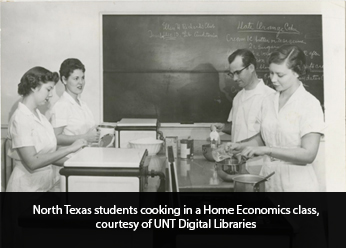
In 1914, the Home Economics Department was established in Domestic Science’s place.
5 years later, the first college degrees were offered (1919). The first B.S. in Home
Economics was administered in 1921, the same year the Department opted to add a vocational
certificate in Home Economics, while also implementing a child development course.
It wasn’t until 1937, however, that the first Master’s degree in Home Economics was
awarded.
A Change of Pace
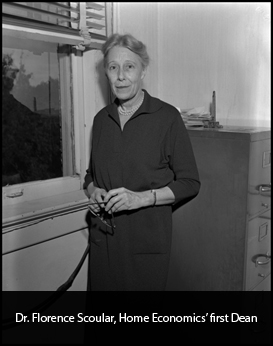
In 1938, Dr. Florence Scoular was named Department Head of Home Economics. By 1941,
she had become the department’s first ever director, and oversaw the transition of
the Department to the School of Home Economics in 1946, becoming its Dean that same
year.
In Dr. Scoular’s time as Dean of the School of Home Economics, she was revered. She helped to expand the School to include Foods and Nutrition, Home and Family Life, and General Home Economics. These programs were a sign of what was to come, and marked the first transition to Hospitality and Merchandising.
In 1961, Dr. Scoular saw Home Economics move to the Education-Home Economics building
in 1961 (now Matthews Hall). Here, cooking labs were opened for students. Dr. Scoular
retired in 1968 and died in 1972, but her legacy still lives on at UNT.
A Permanent Shift
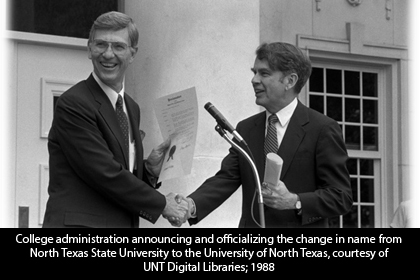
The 80s were a whirlwind for UNT—then North Texas State University (NTSU). Its name
change in 1988 to the University of North Texas stemmed from the need to change with
the times—a trend started by CMHT.
And it all began with a task.
In 1984, the School of Home Economics’ dean, Dr. Suzanne LaBrecque, was tasked with
tracking down industry support to build connections with local hotels and restaurants.
Never having taken a business course, LaBrecque, with the help of Chancellor Hurley,
successfully established connections that are still in place today.
In 1985 the School of Home Economics began offering a specialization in Fashion Design. The School underwent a name change to the School of Human Resource Management offering all existing programs except Consumer Economics and Resource Management in 1986.
In 1988 the Child Development program was moved to the Department of Elementary, Early Childhood and Reading Education in the College of Education. In 1989, the School of Human Resource Management offered Bachelor of Science Degrees in Hotel and Restaurant Management and Human Resource Management (with specializations in Merchandising, Clothing and Textiles, Clothing and Textiles Fashion Design, and Housing). The School no longer offered majors in Foods and Nutrition and Vocational Home Economics.
In 1991, the School no longer offered the Clothing and Textiles Fashion Design major. Home Furnishings Merchandising was added to the Housing specialization. The Master of Science degree was offered for the first time in Hotel and Restaurant Management.
In 1992, the School underwent another name change to the School of Merchandising and Hospitality Management. The programs offered were Merchandising, Home Furnishings Merchandising, and Hotel and Restaurant Management.
By1994, the Bachelor of Science with a major in Home Furnishings Merchandising was offered, but the Housing specialization was deleted. The Bachelor’s degree with a major in Human Resource Management was replaced by the major in Merchandising.
In 1999 the program name for Hotel and Restaurant Management was changed to Hospitality Management, for both undergraduate and undergraduate programs. By that time, the School of Merchandising and Hospitality Management offered Bachelor Degrees in Hospitality Management, Home Furnishings Merchandising, and Merchandising. Graduate degrees included the M.S. Hospitality Management and Industrial-Technical Merchandising and Fabric Analytics (Merchandising), and a combined MS/MBA in both Merchandising and Hospitality Management. The MBA/MS are offered through the School of Merchandising and Hospitality Management and the College of Business Administration.
In 2013, the School of Merchandising and Hospitality Management became the College of Merchandising, Hospitality and Tourism with two departments: Merchandising and Digital Retailing and Hospitality Management. This name change reflected a strategic rebranding to better represent the breadth and global scope of the programs offered. The transition aligned with UNT’s efforts to elevate the school’s visibility and academic identity within industries like fashion, retail, hospitality, and tourism. The new name emphasized the college’s expanded focus on consumer experience, international business, and interdisciplinary education. The change also coincided with the re-vamp of the (now named) B.S. in Digital Retailing and launch of innovative programs like the B.S. in Consumer Experience Management, both the first of their kind in the nation
In the early 2020s, the College phased out the MBA/MS programs, and added concentrations in the Ph.D. in Information Science. Additionally, the (now renamed), Department of Hospitality, Event and Tourism Management launched the B.S. in Event Design and Experience Management and the MS in Hospitality and Tourism Data Analytics. In the Merchandising and Digital Retailing Department, the B.S. in Home Furnishings Merchandising was changed to a concentration in the B.S. in Merchandising, which now consists of two concentration choices: Fashion Merchandising and Furniture and Décor Merchandising. In addition, a second master’s degree option was added, Merchandising and Consumer Analytics, the B.S. in Digital Retailing was renamed Digital Business and E-Commerce and the B.S. in Consumer Experience Management was renamed Interdisciplinary Studies in Consumer Insights.
In Fall 2026, the College of Merchandising and Hospitality Management will become a School in the G. Brint Ryan College of Business.